“We had a tagline once. We dropped it, and nobody missed it. Why do we need one now?”
That’s the gist of what a nonprofit leader asked me, and I got it. Most of us have dealt with a tagline that did nothing. It showed up on the letterhead, sat under the logo for a few years, and then just… disappeared.
But I don’t think that leader proved that taglines don’t matter. What I think he proved was that a weak one doesn’t.
Maybe nobody missed his org’s tagline because it never said anything worth missing, or because nobody inside the building ever used it as a rallying cry (if it even was a cry worth rallying around).
Use a good tagline and people notice. More than that, they feel. Then they repeat it without being asked, staff use it to make decisions, and the people you serve lean in when they hear it.
That’s why, for churches and nonprofits, a tagline isn’t a nice-to-have. It’s a must.
What a tagline is, and what it isn’t
A tagline is a short, deliberate phrase that captures the heart of a brand. In a few words, it says what you believe, who you serve, and how you show up.
A tagline isn’t decoration. It’s who you are, said in few enough words to go everywhere your logo goes: the sign out front, the bottom of a giving letter, the back of a volunteer T-shirt, the last line of a Sunday welcome.
A tagline also isn’t your Brand Soul™ (how people experience you, what you stand for, and what people get from you). Your Brand Soul is for you and your team, not your audience, so it never gets printed. Think of it as your DNA. Nobody sees it, but everything else, your tagline included, is affected by it.
That’s why the tagline comes last in my process. I start with the Brand Soul, build everything else on top of it, and write the tagline as part of the voice of the brand.
The shortcut to an emotional connection
Every strong brand runs on emotional connection. People don’t choose a church, give to a ministry, or volunteer for a cause because of a list of facts. They choose the one that makes them feel something: seen, hopeful, part of something bigger. That feeling is what turns a brand name into a relationship.
How the big brands buy that feeling
Nike’s name, on its own, means nothing to most people. The feeling you get when you see it was built on purpose, one ad, one athlete, and one campaign at a time, with billions of dollars over the course of 30 years behind it. Over decades, all that spending attached a feeling to a word and a swoosh. Now the logo can stand alone because the money did the work.
That’s the playbook for the world’s biggest brands: generate the same feeling so often, in so many places, that it sticks to your name. It works. It’s also wildly expensive.
You don’t have that budget, and you don’t need it
Your church or nonprofit will never have a billion-dollar ad budget. Most of the people you’re trying to reach will meet you in small fragments: a sign on the drive home, an envelope in the mail, a post someone shared, a friend’s invitation. Each of those moments lasts a few seconds.
Your name alone usually can’t carry a feeling in that time, because nobody has the marketing budget to teach people what it means. But a tagline can.
It’s the most affordable shortcut I know to the emotional connection the big brands pay for. A handful of the right words does the work millions in advertising do for them. It tells people, in a few seconds, how they’re going to feel about you before they know anything else.
What that looks like
Bay Hills is a church in Richmond, California. A lot of the people walking through their doors have tried everything that promised to make them feel alive: the paycheck, the relationship, the next big thing. None of it delivered. The name “Bay Hills” tells them where the church is. It can’t tell them what happens inside.
So the tagline I wrote for them does that in three words: Come to life.
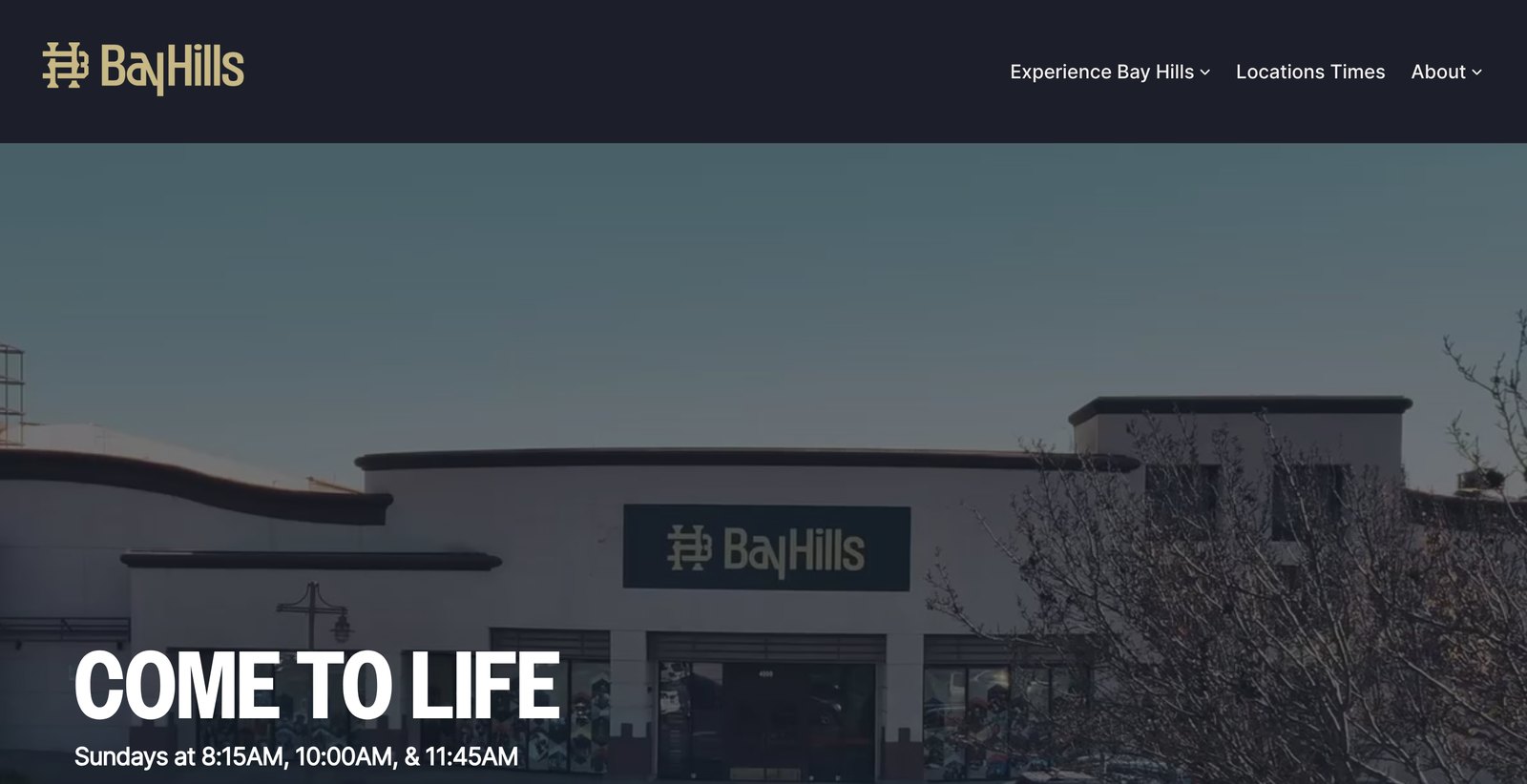
It’s an invitation and a promise at the same time. “Come to life,” as in come where life is happening. “Come to life,” as in this is where dead things start breathing again.
That’s not wordplay for its own sake. In three words, it’s the church’s core belief: Jesus brings dead things to life, and he’s doing it here.
“Come to life” lands differently depending on who hears it. If you already call Bay Hills home, it sounds like Jesus in Matthew 11:28. “Come to me, all you who are weary and burdened, and I will give you rest.” If you’ve never set foot inside Bay Hills, “Come to life” sounds like Jesus at Lazarus’s tomb in John 11, when he called a dead man to walk out.
Same three words, two invitations, both from Jesus.
That’s what a tagline can do that a name can’t. The name says where. The tagline says what will happen to you there.
Taglines do the same work outside the church. I also wrote the tagline for ana kate, a cycle and pregnancy tracking app for women who want to understand their bodies without setting aside what they believe. The name “ana kate” sounds like a friend, but it can’t tell a woman what the app does or what it’s built on.
So the tagline tells her both: Track what’s true.

“Track” is what the app does. “What’s true” is what it’s built on: biological truth and biblical truth.
On the biological side, God designed a woman’s body with patterns she can learn to read, and the app helps her notice them. Those patterns aren’t random, and her body isn’t broken. She is, in the words of Psalm 139:14, “fearfully and wonderfully made.”
On the biblical side, “track” has nothing to do with data. It means living in step with God’s Word, which never changes. As Jesus prayed in John 17:17, “your word is truth.”
Why taglines work
- We feel before we think. People decide how they feel about you before they process what you do. A tagline gets to them first, before your About page and before your sermon or your impact report.
- It costs almost nothing to repeat. A marketing or fundraising campaign costs money every time it runs. A tagline costs nothing on the sign, the shirt, the email footer, the giving envelope, or the end of a video. Every repetition builds the same feeling, for free.
- Your people carry it where marketing can’t. When staff, members, and volunteers say the line, they take it into places no campaign will ever reach: the break room, the bleachers, the dinner table. A tagline your own people believe gets passed along person to person.
- It turns your name into a promise. Pair the two and your name stops being a label and starts meaning something.
That’s why I push every organization I work with to have a tagline. When they adopt one, I encourage them to lock it up with their word mark so the two always travel together.
And once you find the right tagline, keep it. The feeling only sticks if the words stay put long enough to sink in.
Why every nonprofit needs a tagline
If you lead a church, a ministry, or a nonprofit, you have more reasons to need a tagline than any for-profit brand does, not fewer. The emotional shortcut is only the start.
- You’re selling something nobody can hold. A coffee company can hand you a cup. You’re asking people to give, serve, or show up for something they can’t see: hope, healing, a changed life. A tagline puts that invisible thing into words people feel and understand.
- Your name probably isn’t doing the job. Most nonprofit names are built from a place, a founder, a Bible reference, or words like International, Ministries, and Foundation. They tell people what you are or what you do. They rarely tell people why they should care.
- You’re competing for the same few milliseconds as every other good cause. Your appeal lands in the same inbox and mailbox as dozens of others. Donors don’t sort them by reading mission statements. They sort them by what they feel at first glance.
- You have more voices than you can manage. Staff, board members, volunteers, chapters, the pastor or CEO, and now AI tools writing your copy. Without a shared tagline, each of them describes you a little differently, and over time you sound like a dozen organizations instead of one.
- Your people turn over. Volunteers rotate, staff move on, and board seats change. A tagline is the one piece of your story a brand-new volunteer can say correctly on day one.
- It keeps you from drifting. Organizations rarely abandon their mission on purpose. They drift through small, well-meaning decisions that put something else first. A clear tagline gives everyone a quick test for every new program, campaign, or partnership: does this fit the line, or pull us away from it?
None of that takes a big budget. It takes a few right words, used everywhere, for a long time.
Why so few organizations have one
So why don’t more organizations have a good tagline? Most I meet either don’t have one or have one nobody remembers. I don’t think that’s laziness. Writing a good tagline is hard work.
A tagline has to say who you are, who you’re for, and why it matters, in a handful of words, without sounding like anyone else. Every word has to earn its place. Most of the work is the lines you throw away.
It’s also one of the few things AI still isn’t very good at, at least not yet. Ask a chatbot for a tagline and you’ll get 20 in 10 seconds. Most of them will be fine. That’s the problem. “Fine” sounds like everyone else.
AI is built to give you what’s typical, and a tagline has to be the one line only you could say. Getting there takes knowing your people, your history, the convictions you stand on, and the hurts in your community. For now, that still takes a person.
Heart, head, and soul
Every tagline I write has to pass three tests at once. It has to work emotionally, rationally, and spiritually, so that however someone meets it, something true connects.
Heart: it makes people feel something before they think anything. It has to do that before your brand ever says a full sentence.
Head: it tells people what you are and what makes you different. The strongest ones finish the thought your name starts.
Soul: it’s rooted in something deeper than marketing. For a ministry, the line has to be compatible with Scripture, even when it doesn’t quote it.
Where taglines go wrong
Most bad taglines fail in one of a few predictable ways.
- They try to say everything. I’ve seen plenty of taglines that were really mission statements: a full sentence about everything the organization does. True, but nobody will repeat it. A mission statement is for your board. A tagline is for the person scrolling past your post.
- They’re about you instead of them. A lot of taglines describe what you do. The ones that work talk to the person you’re trying to reach.
- They speak to the head and skip the heart. One group I work with has used half a dozen taglines over the years. All are accurate, and none has made anyone feel anything.
- They compete with each other. When leaders can’t agree on a tagline, staff fill the gap. Internal phrases start showing up in email signatures and donor pieces, and suddenly you have dueling taglines and no voice at all.
Even when the name does the work
Every so often, a name carries the big idea on its own. I recently told a client they didn’t need a classic tagline because their new name already said it.
But they still needed one simple sentence that tells people what kind of organization they are, for the website header, the Google listing, and every social bio. Even there, the principle holds. No organization gets to skip the few words that tell people who you are in a few seconds.
Pull up your tagline, or the line you’ve been using as one. Then ask:
- What would someone feel in the first three seconds? Not what they’d understand. What they’d feel. If the honest answer is nothing, it’s doing the head’s job and skipping the heart’s.
- Who is it about? Count the words that describe you and the words that speak to the person you serve. The best lines are an invitation, not a description.
- If you dropped it tomorrow, would anyone miss it? Be honest. That answer tells you more than any focus group.
If those questions are hard to answer, the problem usually isn’t the tagline. It’s what’s underneath it.